In algebra, a multivariate polynomial

f ( x ) = α a α x α , where  α = ( i 1 , , i r ) N r , and  x α = x 1 i 1 x r i r , {\displaystyle f(x)=\sum _{\alpha }a_{\alpha }x^{\alpha }{\text{, where }}\alpha =(i_{1},\dots ,i_{r})\in \mathbb {N} ^{r}{\text{, and }}x^{\alpha }=x_{1}^{i_{1}}\cdots x_{r}^{i_{r}},}

is quasi-homogeneous or weighted homogeneous, if there exist r integers w 1 , , w r {\displaystyle w_{1},\ldots ,w_{r}} , called weights of the variables, such that the sum w = w 1 i 1 w r i r {\displaystyle w=w_{1}i_{1} \cdots w_{r}i_{r}} is the same for all nonzero terms of f. This sum w is the weight or the degree of the polynomial.

The term quasi-homogeneous comes from the fact that a polynomial f is quasi-homogeneous if and only if

f ( λ w 1 x 1 , , λ w r x r ) = λ w f ( x 1 , , x r ) {\displaystyle f(\lambda ^{w_{1}}x_{1},\ldots ,\lambda ^{w_{r}}x_{r})=\lambda ^{w}f(x_{1},\ldots ,x_{r})}

for every λ {\displaystyle \lambda } in any field containing the coefficients.

A polynomial f ( x 1 , , x n ) {\displaystyle f(x_{1},\ldots ,x_{n})} is quasi-homogeneous with weights w 1 , , w r {\displaystyle w_{1},\ldots ,w_{r}} if and only if

f ( y 1 w 1 , , y n w n ) {\displaystyle f(y_{1}^{w_{1}},\ldots ,y_{n}^{w_{n}})}

is a homogeneous polynomial in the y i {\displaystyle y_{i}} . In particular, a homogeneous polynomial is always quasi-homogeneous, with all weights equal to 1.

A polynomial is quasi-homogeneous if and only if all the α {\displaystyle \alpha } belong to the same affine hyperplane. As the Newton polytope of the polynomial is the convex hull of the set { α a α 0 } , {\displaystyle \{\alpha \mid a_{\alpha }\neq 0\},} the quasi-homogeneous polynomials may also be defined as the polynomials that have a degenerate Newton polytope (here "degenerate" means "contained in some affine hyperplane").

Introduction

Consider the polynomial f ( x , y ) = 5 x 3 y 3 x y 9 2 y 12 {\displaystyle f(x,y)=5x^{3}y^{3} xy^{9}-2y^{12}} , which is not homogeneous. However, if instead of considering f ( λ x , λ y ) {\displaystyle f(\lambda x,\lambda y)} we use the pair ( λ 3 , λ ) {\displaystyle (\lambda ^{3},\lambda )} to test homogeneity, then

f ( λ 3 x , λ y ) = 5 ( λ 3 x ) 3 ( λ y ) 3 ( λ 3 x ) ( λ y ) 9 2 ( λ y ) 12 = λ 12 f ( x , y ) . {\displaystyle f(\lambda ^{3}x,\lambda y)=5(\lambda ^{3}x)^{3}(\lambda y)^{3} (\lambda ^{3}x)(\lambda y)^{9}-2(\lambda y)^{12}=\lambda ^{12}f(x,y).}

We say that f ( x , y ) {\displaystyle f(x,y)} is a quasi-homogeneous polynomial of type (3,1), because its three pairs (i1, i2) of exponents (3,3), (1,9) and (0,12) all satisfy the linear equation 3 i 1 1 i 2 = 12 {\displaystyle 3i_{1} 1i_{2}=12} . In particular, this says that the Newton polytope of f ( x , y ) {\displaystyle f(x,y)} lies in the affine space with equation 3 x y = 12 {\displaystyle 3x y=12} inside R 2 {\displaystyle \mathbb {R} ^{2}} .

The above equation is equivalent to this new one: 1 4 x 1 12 y = 1 {\displaystyle {\tfrac {1}{4}}x {\tfrac {1}{12}}y=1} . Some authors prefer to use this last condition and prefer to say that our polynomial is quasi-homogeneous of type ( 1 4 , 1 12 ) {\displaystyle ({\tfrac {1}{4}},{\tfrac {1}{12}})} .

As noted above, a homogeneous polynomial g ( x , y ) {\displaystyle g(x,y)} of degree d is just a quasi-homogeneous polynomial of type (1,1); in this case all its pairs of exponents will satisfy the equation 1 i 1 1 i 2 = d {\displaystyle 1i_{1} 1i_{2}=d} .

Definition

Let f ( x ) {\displaystyle f(x)} be a polynomial in r variables x = x 1 x r {\displaystyle x=x_{1}\ldots x_{r}} with coefficients in a commutative ring R. We express it as a finite sum

f ( x ) = α N r a α x α , α = ( i 1 , , i r ) , a α R . {\displaystyle f(x)=\sum _{\alpha \in \mathbb {N} ^{r}}a_{\alpha }x^{\alpha },\alpha =(i_{1},\ldots ,i_{r}),a_{\alpha }\in \mathbb {R} .}

We say that f is quasi-homogeneous of type φ = ( φ 1 , , φ r ) {\displaystyle \varphi =(\varphi _{1},\ldots ,\varphi _{r})} , φ i N {\displaystyle \varphi _{i}\in \mathbb {N} } , if there exists some a R {\displaystyle a\in \mathbb {R} } such that

α , φ = k r i k φ k = a {\displaystyle \langle \alpha ,\varphi \rangle =\sum _{k}^{r}i_{k}\varphi _{k}=a}

whenever a α 0 {\displaystyle a_{\alpha }\neq 0} .

References


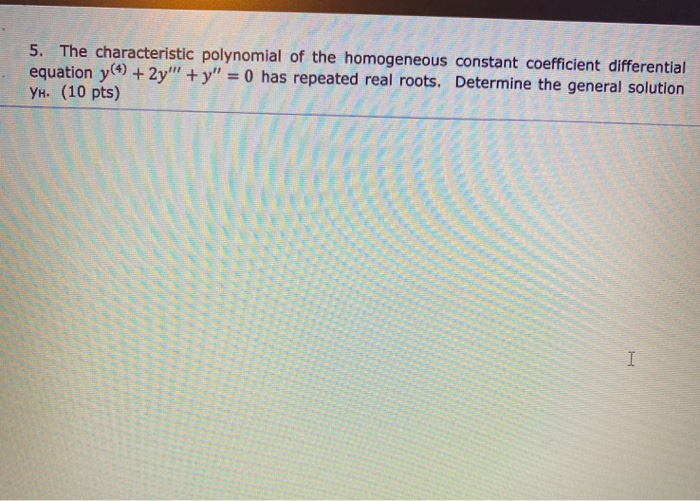
Solved 5. The characteristic polynomial of the homogeneous

Solved is a quadratic homogeneous polynomial. If Δ2=0 , what

Solved Show that a polynomial p(x,y) is homogeneous of

Root of quasi polynomial (11). Download Scientific Diagram

Stability regions for quasipolynomial (5) for p Download Scientific