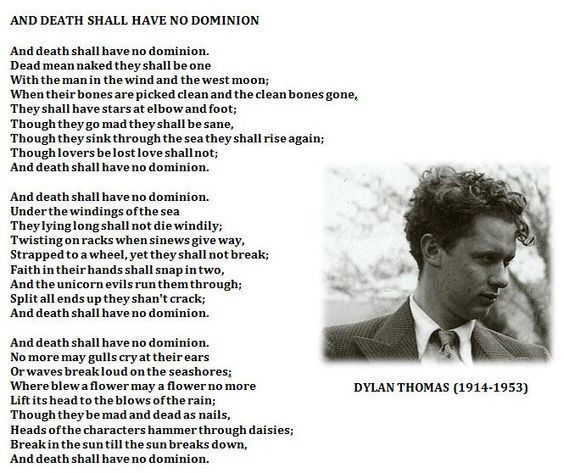
"And death shall have no dominion" is a poem written by Welsh poet Dylan Thomas (1914–1953). The title comes from St. Paul's epistle to the Romans (6:9): "Christ being raised from the dead dieth no more; death hath no dominion over him." The poem portrays death as a guarantee of immortality, drawing on imagery from John Donne's Devotions Upon Emergent Occasions.
Poem
Publication history
In early 1933, Thomas befriended Bert Trick, a grocer who worked in the Uplands area of Swansea. Trick was an amateur poet who had several poems published in local papers. In spring 1933, Trick suggested the two men both write a poem on the subject of 'immortality'. Trick's poem, which was published in a newspaper the following year, contained the refrain "For death is not the end." In 1933, in a notebook marked 'April', Thomas wrote the poem "And death shall have no dominion". Trick persuaded him to seek a publisher and in May of that year it was printed in New English Weekly.
On 10 September 1936, two years after the release of his first volume of poetry (18 Poems), Twenty-five Poems was published. It revealed Thomas's personal beliefs pertaining to religion and the forces of nature, and included "And death shall have no dominion".
Cultural references
The poem was set to music by Paul Kelly in his album Nature (2018). The titles of the novels They Shall Have Stars (1956) by James Blish and No Dominion (2006) by Charlie Huston are both taken from the poem. Mithu Sanyal quotes the poem at length in her novel Identitti (2022). Disc 2 of UNKLE Sounds' release Edit Music For A Film (2005) features the first verse of the poem, played over an UNKLE Sounds edit of Next Life/Is That What Everybody Wants. The first stanza was spoken by the lead character in the 2002 Steven Soderberg film Solaris.
Notes
Bibliography
- Ferris, Paul (1989). Dylan Thomas, A Biography. New York: Paragon House. ISBN 1-55778-215-6.